


Week covered: 19 June - 26 June 2026

Welcome back.
Another significant week for AI in the UK—and this time the focus is firmly on scale.
Across research, employment, policing, and financial services, organisations are investing heavily in the next phase of AI adoption. New government-backed research labs are being launched, demand for AI talent continues to outpace the wider jobs market, and major institutions are increasingly looking to AI as a way to improve efficiency, productivity, and long-term competitiveness.
What's becoming clear is that AI is no longer sitting alongside business strategy. It is increasingly becoming part of it.
In this edition, we're covering the UK's new £60M AI research initiative, rising demand for AI talent across the economy, the Metropolitan Police's extended AI partnership with Palantir, and Santander's plans to generate hundreds of millions in savings through expanded AI deployment.

UK launches £60M AI research labs to make AI cheaper, faster and more reliable
Published: 23 June 2026
The UK government has announced two new AI research laboratories backed by £60 million in funding, with the aim of making AI systems cheaper to run, easier to deploy, and more reliable in real-world environments.
The initiative will establish specialist research centres focused on tackling some of the biggest barriers to AI adoption, including the high cost of computing power, model efficiency, reliability, and accessibility.
According to the Department for Science, Innovation and Technology, the investment forms part of the UK's wider ambition to strengthen domestic AI capability while helping businesses and public services access more practical and affordable AI solutions.
The research programme will bring together universities, researchers, and industry partners to develop new approaches that could reduce the infrastructure burden associated with advanced AI systems.
One of the biggest challenges facing AI adoption remains cost. While AI capabilities continue to improve rapidly, many organisations still face barriers around infrastructure requirements, implementation complexity, and operational expense.
The new labs are intended to address those challenges directly, helping ensure future AI systems become more efficient and accessible across a wider range of sectors.
For SMEs, developments like this could ultimately help lower the barriers to entry for AI adoption while improving the reliability of the tools businesses increasingly depend on.

Government backs new generation of AI research centres
Published: 23 June 2026
Alongside the funding announcement, details have emerged about how the UK's new AI laboratories will operate and the areas they are expected to focus on.
According to Research Information, the two centres will bring together leading academic institutions and researchers to explore ways of improving AI performance while reducing operational costs.
The laboratories are expected to focus heavily on foundational AI challenges, including model optimisation, energy efficiency, computing requirements, and the development of systems that can perform more reliably in real-world environments.
The launch reflects a growing understanding that future AI competitiveness will not simply be determined by who builds the largest models, but by who develops the most practical, scalable, and efficient systems.
This shift is increasingly visible across the industry. Businesses are becoming less focused on AI capability in isolation and more interested in usability, deployment, cost-effectiveness, and measurable business outcomes.
For the UK, the research initiative reinforces efforts to strengthen domestic AI expertise while supporting innovation that can translate into commercial applications.
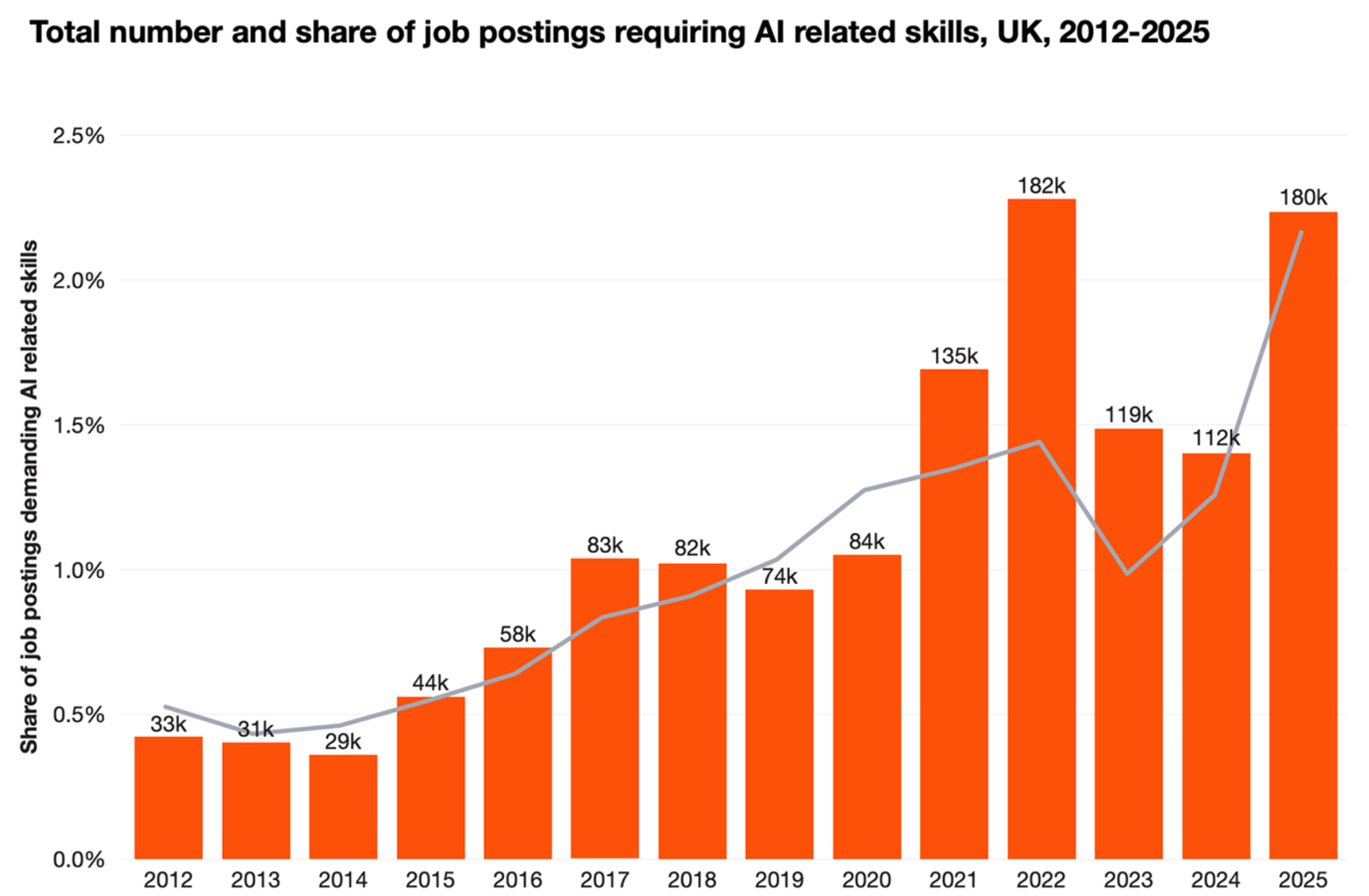
AI hiring and salaries surge as demand outpaces wider jobs market
Published: 24 June 2026
Demand for AI talent continues to accelerate across the UK, with new research showing AI-related hiring and wages are significantly outperforming the broader jobs market.
According to Consultancy.uk, organisations across multiple sectors are increasing recruitment efforts as they compete for employees with AI-related skills and experience.
The findings highlight how businesses are increasingly treating AI capability as a strategic requirement rather than a specialist function.
As adoption grows, organisations are seeking professionals who can bridge the gap between AI technology and business operations, helping implement systems, manage workflows, and deliver measurable results.
The increase in salaries reflects growing competition for talent, particularly in areas such as machine learning, data science, AI engineering, automation, and implementation strategy.
Importantly, the trend extends beyond technology companies. Businesses across finance, professional services, healthcare, manufacturing, and retail are all looking to strengthen AI capability internally.
For SMEs, this reinforces an important challenge: access to AI tools is becoming easier, but access to skilled people remains highly competitive.

Metropolitan Police extends Palantir AI project after previous delay
Published: 24 June 2026
The Metropolitan Police has received an extension for its AI-related project with Palantir after a previously proposed agreement was blocked by London's mayor.
According to The Guardian, the extension allows work to continue while discussions around governance, oversight, and procurement arrangements progress.
The project forms part of broader efforts to improve how data is managed and analysed across policing operations.
Palantir, which specialises in large-scale data platforms and analytics systems, has increasingly become involved in public sector projects where large volumes of information require processing and analysis.
The extension highlights a wider theme emerging across AI adoption: organisations are increasingly balancing innovation opportunities with concerns around governance, transparency, and public trust.
As AI systems become more integrated into public services and decision-making processes, scrutiny around oversight and accountability continues to increase.
For businesses, the story reinforces that successful AI adoption is not simply a technical challenge—it also requires strong governance and stakeholder confidence.

Santander targets £433M savings through expanded AI deployment
Published: 25 June 2026
Santander's parent group is targeting approximately £433 million in savings through an expanded AI strategy designed to improve efficiency across operations.
According to reports, the bank plans to use AI more extensively across areas including customer service, internal processes, operational efficiency, and decision support.
Financial institutions continue to be among the largest investors in AI globally, driven by the potential to reduce costs, improve service delivery, and strengthen productivity.
The scale of Santander's target highlights how organisations are increasingly moving beyond experimentation and setting measurable financial objectives around AI implementation.
Rather than viewing AI purely as an innovation initiative, businesses are increasingly treating it as an operational tool capable of delivering quantifiable business outcomes.
For SMEs, the lesson is familiar but increasingly important: the strongest AI strategies are often tied directly to efficiency gains, productivity improvements, and clearly defined commercial objectives.
One-minute explainer
Here are the tech / AI terms used in this edition, explained simply:
AI Research Lab — A dedicated research centre focused on developing and improving AI technologies.
Model Optimisation — Improving AI performance while reducing computing requirements and costs.
AI Talent Gap — The growing difference between demand for AI-skilled workers and available supply.
AI Governance — The frameworks and oversight used to manage AI safely and responsibly.
Operational AI — AI systems deployed directly into business processes and day-to-day operations.
Closing Note
This week highlighted how the UK's AI ecosystem is continuing to mature.
The conversation is becoming less about whether AI works and more about how organisations can deploy it efficiently, affordably, and at scale. Research funding is increasingly focused on reducing barriers to adoption, businesses are competing aggressively for AI talent, and major institutions are setting clear financial objectives tied directly to implementation.
At the same time, governance, trust, and oversight remain central to the discussion as AI moves deeper into both public and private sector operations.
For SMEs, the direction of travel is becoming increasingly clear.
The next competitive advantage may not come from simply accessing AI tools, but from combining the right technology, the right people, and the right implementation strategy to generate measurable business outcomes.
We’ll be back next week with more hand‑picked updates and clear actions.
If you’d like us to focus next time on a specific area (for example: finance workflows, marketing automation, product development) just email us at hello@jabelai.uk and we’ll gear the next issue accordingly.
Until next week,
The Jabel AI Solutions Team